

Huawei


A charge point that belongs to your energy system rather than sitting next to it. Set it from your phone, plug in, and let the house work out when the car charges.
Get your EV charger offerThe car is parked at home more than anywhere else, and that is what makes home the easiest place to keep it charged.
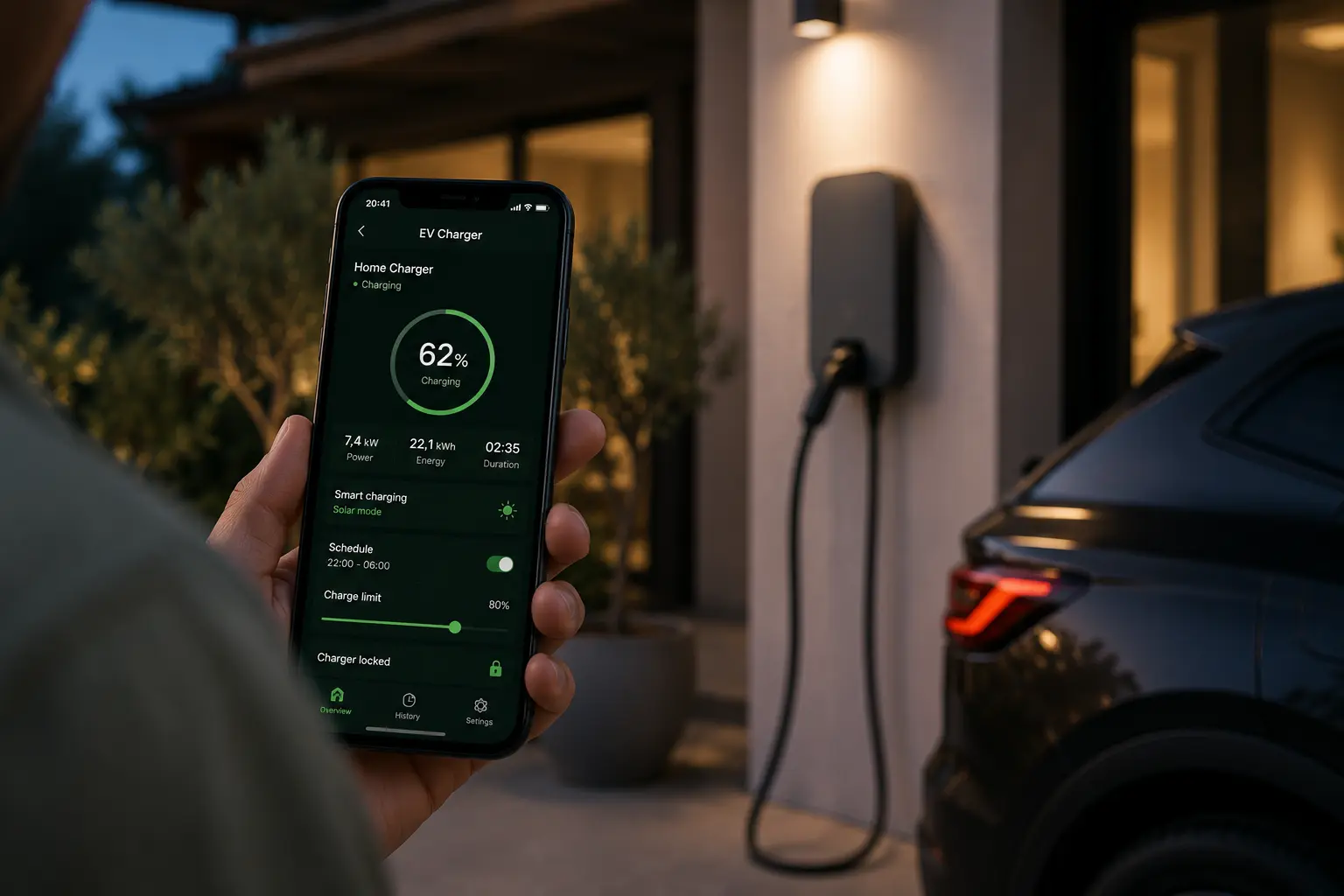
Everything the charge point does is on one screen, and most people set it once and then forget it is there. It earns its place on the evening the car has to be full by six, and on the morning you want to know what last night actually cost.
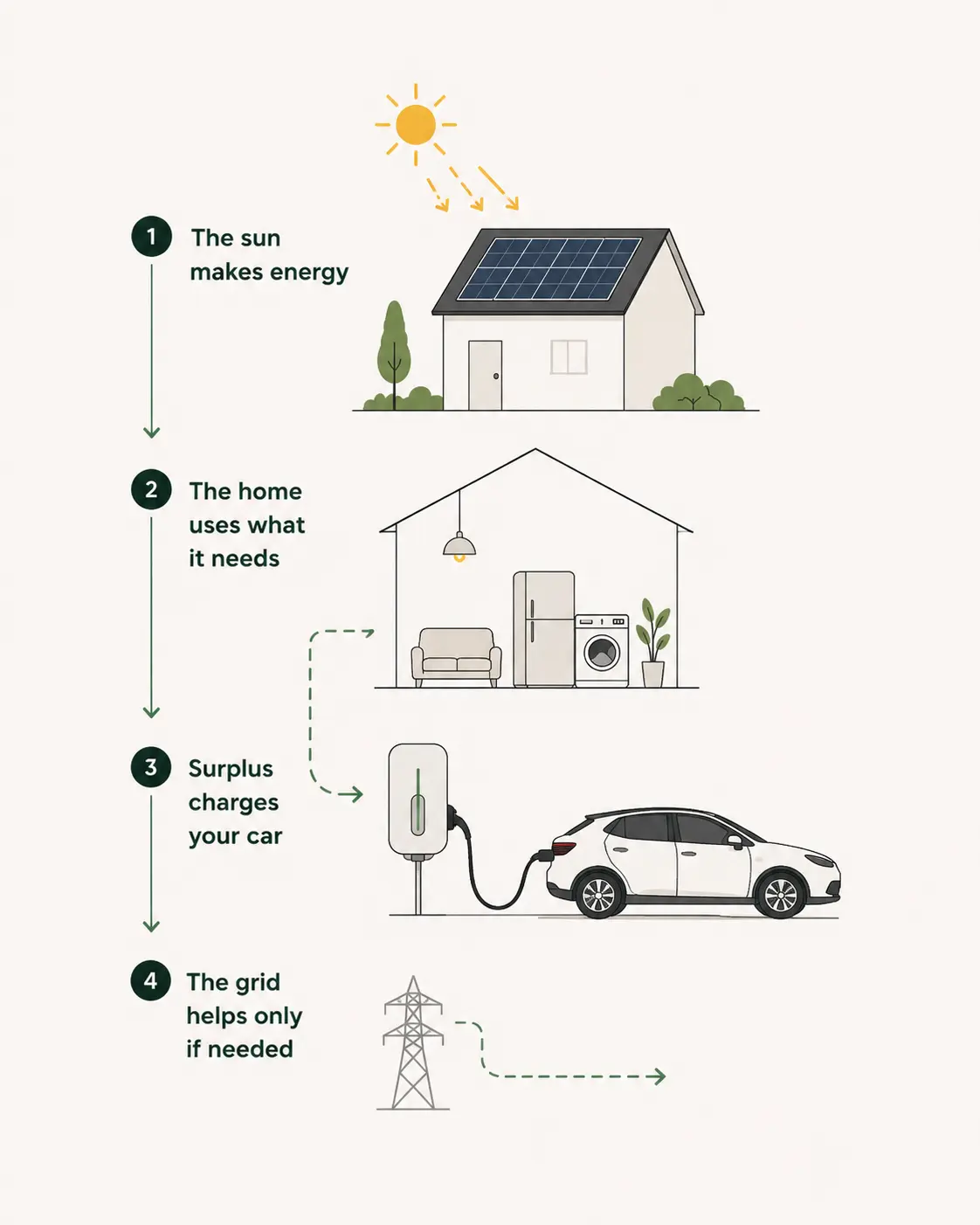
Your roof makes electricity, the house takes what it needs, and whatever is spare can go to the car. The grid covers the rest.
How much of a charge really comes from the sun depends on what the roof is producing, what the house is drawing at the time, whether the car is home while the sun is up, and how the system is set up. We go through all four with you before anything is fitted.
Book a free survey
A car is one of the larger things you will ever plug into a house, and it draws steadily for hours. So the charger, the charging power and the wiring behind it are chosen to suit your electrical installation rather than fitted to whatever is nearest.
That is our part of the job, and it is settled before the quotation rather than on the day.
The right charger depends on your home rather than on a datasheet, so there is no specification sheet here. We recommend one of these two with the quotation and tell you what made the difference for your house.
Huawei

Deye
Yes, and that is the reason to fit a charge point into the system rather than beside it. It reads what the roof is making and what the house is using, and gives the car the difference. How much of your charging that covers depends on your week, which we go through at the survey.
How solar charging worksYes, and it is the change most people notice first. Charging at home costs the retail price of your electricity and nothing on top, where public charging carries the hardware, the site and the convenience as well. Panels make it cheaper again later, and a charge point fitted now is ready for them.
What charging costs, and whereYes. Charge status, start and stop, a schedule, and what the car has used over the week. Most people set it up on the first day and then leave it alone.
What the app doesUsually. It is a much smaller job than the original installation, and what decides it is the inverter you already have rather than the panels. Some can tell a charge point what the surplus is and some cannot, so that is the first thing we check.
What the inverter decidesNo. A charge point works with panels alone, and a battery bought only for the car is rarely the cheapest way to charge it. Storage earns its place on the evenings and the power cuts first, and the car is a good reason to size it generously rather than a reason to buy one.
How storage helpsThat is our job rather than yours. Both of the ones we fit do the same thing well, and which suits you falls out of the inverter, the supply and how the car is used. We name one in the quotation and explain what made the difference.
What to ask before you buyYes, and on a Cyprus property it usually is. What we look at on the day is where the cable reaches comfortably and how much afternoon sun the wall takes, because shade is kinder to any equipment through a Cyprus summer.
Where the charge point goesFor a normal day's driving, a couple of hours. For a nearly empty battery, overnight. The exact rate depends on the supply, the charge point and what the car itself will accept, and we put all three in writing with the quotation.
What your supply allowsWe look at three things together: the car and the week it does, the property and what its supply can carry, and the energy system you have or are planning. The charge point is chosen from those rather than before them.
Get your EV charger offerIf your existing inverter cannot follow production, we will tell you that before anything is quoted.
Everything above is about what we would fit. Below is the part you can use whoever installs it, and most of it applies whether or not you have panels: what your driving uses, what a year of it costs at home against a public charger, and what to look at before anyone drills a wall.
The car fills while it is parked, which is most of its life. You leave in the morning with a full battery and you stop thinking about fuel.
A car spends far more time standing still than moving. At home, overnight and across the weekend, it is standing still right next to your own supply.
That is the whole idea. Charging stops being an errand and becomes something that happens while you sleep.
It also makes the car the most useful load in the house. A fridge runs when it wants to and the cooking happens at dinner time, but a car parked until Monday morning does not care whether it charges at two in the afternoon or two in the morning.
That flexibility is worth having on its own, and it is worth more again if you have panels on the roof.
A parked car is a large, patient load, and patience is what makes it cheap and easy to look after at home.
Two numbers and one multiplication. Once you know roughly how many kilowatt-hours a year the car needs, every other decision in this guide gets easier.
Cars are quoted in kilowatt-hours per 100 km. Around 17 is a reasonable working figure for a family car, and yours will be a little above or below it.
For the distance, use your own rather than an average. Your odometer or your last service invoice will tell you in a minute, and it beats any figure we could print.
If you want something to compare against, the average car in the EU covers around 10,800 km a year. We have not found a published figure for Cyprus, and a small island with short journeys can sit either side of that, so your own number is the one worth using.
Your kilometres
Driven in a year
About 17 kWh
Used per 100 km
Your kilowatt-hoursInto the car over a year
| A year of driving | Roughly what the car uses |
|---|---|
| 5,000 km | Roughly what the car usesAbout 850 kWh |
| 10,000 km | Roughly what the car usesAbout 1,700 kWh |
| 15,000 km | Roughly what the car usesAbout 2,500 kWh |
| 20,000 km | Roughly what the car usesAbout 3,400 kWh |
Find your own annual kilowatt-hours before you look at equipment. It is the number every other decision hangs off.
Charging at home is the cheap way to run an electric car whether or not you have panels. Public charging is priced for journeys rather than for every day.
A public charger has to pay for its hardware, its site, its grid connection and the convenience of being there the moment you need it. That is a fair price for what it is, and it is a good deal more than the electricity inside it.
As a rule of thumb it runs about three times what the same electricity costs at home. Rates move by operator, by connector and by hour, so treat that as the shape rather than as a quote, and check the chargers you actually use.
At home you pay the retail price of your own electricity and nothing on top. For most households that difference is the single largest change an electric car makes to running costs, and it arrives before any solar panel is involved.
Almost everybody does both. Public charging is what gets you to Paphos and back. A charge point at home is what quietly moves the rest of the year onto the cheaper of the two.
To put your own figure on it, take the kilowatt-hours from chapter two and multiply them by what a unit costs you at home. Then multiply by three and compare.
| Where you charge | Roughly what it costs | What is in the price |
|---|---|---|
| At home | Roughly what it costsThe baseline | What is in the priceYour own electricity, and nothing else |
| In public | Roughly what it costsAround three times as much | What is in the priceThe electricity, plus the hardware, the site and the convenience of it being there |
A home charge point earns its keep on the gap between those two rows, and that gap is there with or without a solar panel.
A charge point is worth having on a house with no panels at all. It charges at the cheapest rate you have access to, it looks after your supply, and it is ready if panels arrive later.
A good share of the charge points we fit go on houses with no solar, and some of those houses never will have any. The charge point still does four useful things.
It charges at household prices: This is the big one and it needs nothing on the roof. Chapter three is the whole argument.
It looks after your supply: Load management keeps the total draw inside your limit, so the car fits the house you already have instead of asking for a bigger connection.
It does the thinking: Set the hours you want it to run, see what the car has used, start and stop from your phone. None of that depends on where the electricity came from.
It is ready for later: If panels or a battery arrive in a few years, a charge point that can already read a system is in place and nothing has to be replaced.
You do not need panels for home charging to be the cheapest and easiest way to run the car. Solar makes a good thing better.
For a house with panels: your roof produces on one shape and your house uses on another. The gap between them in the middle of the day is where car charging fits.
The next five chapters are for a house that has solar or is planning it. If that is not you, chapter ten picks the practical thread back up.
A rooftop system produces nothing before dawn, peaks around midday and stops at dusk. A house does close to the opposite. A little in the morning, less through the middle of the day, and a long evening peak that starts about when production ends.
Lay the two over each other and the overlap is electricity you use as it is made. Everything under the production curve and outside that overlap is surplus.
For most homes that surplus sits in the middle of the day and goes to the grid. A car parked on the drive is the simplest thing in the world to point it at.
The middle of the day is where your spare production lives, and it is the easiest part of the day to give to a car.
A charge point that can read the house gives the car whatever the house is not using, moment by moment. You plug in and leave it.
The charge point is told what the roof is making and what the house is drawing. The difference between those two is the surplus, and that is what goes to the car.
It starts when there is enough to be worth starting, lifts as the sun climbs, drops when the oven goes on and stops when the surplus does.
Most set-ups also let you set a floor. Charge from the sun where you can, and top up from the grid so the car is at a level you choose by an hour you choose.
That floor is worth agreeing before the installation rather than discovering afterwards. It is the setting that decides whether you ever have to think about this again.
What makes it possible is the inverter. It is the part that knows what is being produced and consumed, so it is the first thing we look at on a house that already has solar.
The roof produces
More at midday than at either end of the day.
The house takes its share
Everything running at that moment comes off the top first.
The car takes the surplus
Charging rises and falls with what is left over.
The grid tops up if you asked it to
Only up to the level and the hour you set.
Set the floor once, and solar charging becomes something that happens without you.
Three things decide it, and one of them is simply when the car is at home. Working it out honestly is more useful than any headline percentage.
This is the question worth answering properly before you buy anything, because the answer is different for every household and it is easy to find out.
What moves the share:
What your roof produces: A bigger array leaves more spare in the middle of the day. Production is also much higher in summer than in winter, so the share moves with the season.
What the house is using at the same time: Cooling, a pool pump and a water heater all take from the same surplus. Charging gets what is left after them.
When the car is at home: A car on the drive at midday can take surplus directly. A car that commutes on weekdays does most of its solar charging at the weekend, and storage covers part of the rest.
An illustrative household rather than a Cyprus average. What it shows is that the surplus is comfortably larger than the car needs. How much of it the car actually catches depends on the hours it is parked at home, and that is the part we work out with you.
For most homes with solar there is more spare production than a car needs. The useful question is how much of it the car is home to take.
A unit that goes from your roof into the car costs you the export income you gave up, which is around a third of what the same unit costs from the grid.
Chapter three compared home charging with public charging, and that comparison holds for every household. This chapter is the extra step solar adds on top of it.
Under Cyprus net billing, the electricity you send to the grid and the electricity you buy from it are valued differently. That difference is where home solar charging earns its keep.
When the car takes a unit straight from the roof, the real cost to you is the export income you no longer receive for it. Everything above that is yours.
The figures below are the assumptions we work from rather than a price list. What is worth carrying away is the order and the rough size of the gap between the rows.
| One kilowatt-hour into the car | What it costs you | Why |
|---|---|---|
| From your roof, as it is made | What it costs you0.11 | WhyThe export income you gave up instead |
| From the grid at home | What it costs you0.30 | WhyThe retail price |
| From a public charger | What it costs youMore | WhyThe hardware, the site and the convenience are all in the price |
Charging off your own roof costs roughly a third of charging from the grid, and the order holds even when the figures move.
Storage carries the middle of the day into the evening, which is exactly when a commuting car is plugged in.
If the car is out during daylight, the roof and the car never meet. Storage is how they meet anyway.
The battery fills on the surplus while the car is away and gives it back after dark. The house is served first, and what the house has not used is available to the car.
It is worth being clear about the size of that contribution. A home battery holds an evening's worth of household electricity rather than a full charge for a car, so it extends solar charging rather than replacing the grid.
That is still a good deal of driving for something the roof made earlier the same day.
| Storage | Available in an evening | Roughly how far that drives |
|---|---|---|
| One unit, 5.12 kWh | Available in an eveningAbout 3.7 kWh | Roughly how far that drivesAbout 20 km |
| Two units, 10.24 kWh | Available in an eveningAbout 7.4 kWh | Roughly how far that drivesAbout 40 km |
Storage turns a weekday evening into solar charging time. Size it for the house first and the car benefits from it.
Battery storageThe supply you already have is usually enough, because a charge point can be told what the rest of the house is doing and work within it. True with panels and without them.
A charge point is a substantial load that runs for hours. The question is not whether the cable can carry it, but whether everything running at once can.
Load management is the answer, and it is a setting rather than a building job. The charge point is told what the rest of the property is drawing and keeps the total inside your limit, easing the car back when the oven and the air conditioning are both on.
In practice you never see it happen. The car simply finishes a few minutes later on the evenings the house was busy.
This is also why an upgrade is rarely needed. Most homes have more headroom overnight than they think, and overnight is when most of the charging happens.
| What you have | What it usually means |
|---|---|
| A single phase supply | What it usually meansA managed charge point that shares the supply with the house. Comfortable for a full overnight charge. |
| A three phase supply | What it usually meansMore power available at once, so a full charge in less time when you want one. |
| Solar as well | What it usually meansThe same sharing, with the roof's production counted first so the car takes surplus before it takes anything from the grid. |
Load management gets a car onto the supply you already have, and it costs a great deal less than enlarging it.
Half an hour of thought on the day beats living with a cable that does not quite reach. These are the things worth deciding before anyone drills.
Charge points are made to live outdoors and on a Cyprus property they usually do. What matters is where on the wall.
Park the car where you normally park it, then stand where the cable would have to reach. That five minutes settles most of the decision.
Six questions that get you a design rather than a product. They work on us and on anyone else you talk to.
What will a year of my driving cost to charge at home?
The answer should start with your mileage. It is the question that decides whether the charge point pays for itself, and it does not depend on having solar.
Will my supply take it as it is?
A clear answer here is what makes a quotation complete rather than a starting point.
What happens when the house and the car want power at the same time?
You want to hear how load management works on your supply, described in terms of your own house.
Can this charge point follow solar production?
Worth asking even with no panels today, because it decides whether the same box still suits you if panels arrive later.
If I do have solar, how much of my charging would realistically come from the roof?
Anyone who asks about your week before answering is giving you a figure that means something.
Who looks after it if the charge point and the inverter disagree?
One number to call is worth asking about while you still have a choice.
A good answer to any of these is about your house and your week. That is what a design sounds like.
How we design every system