
Skip to content
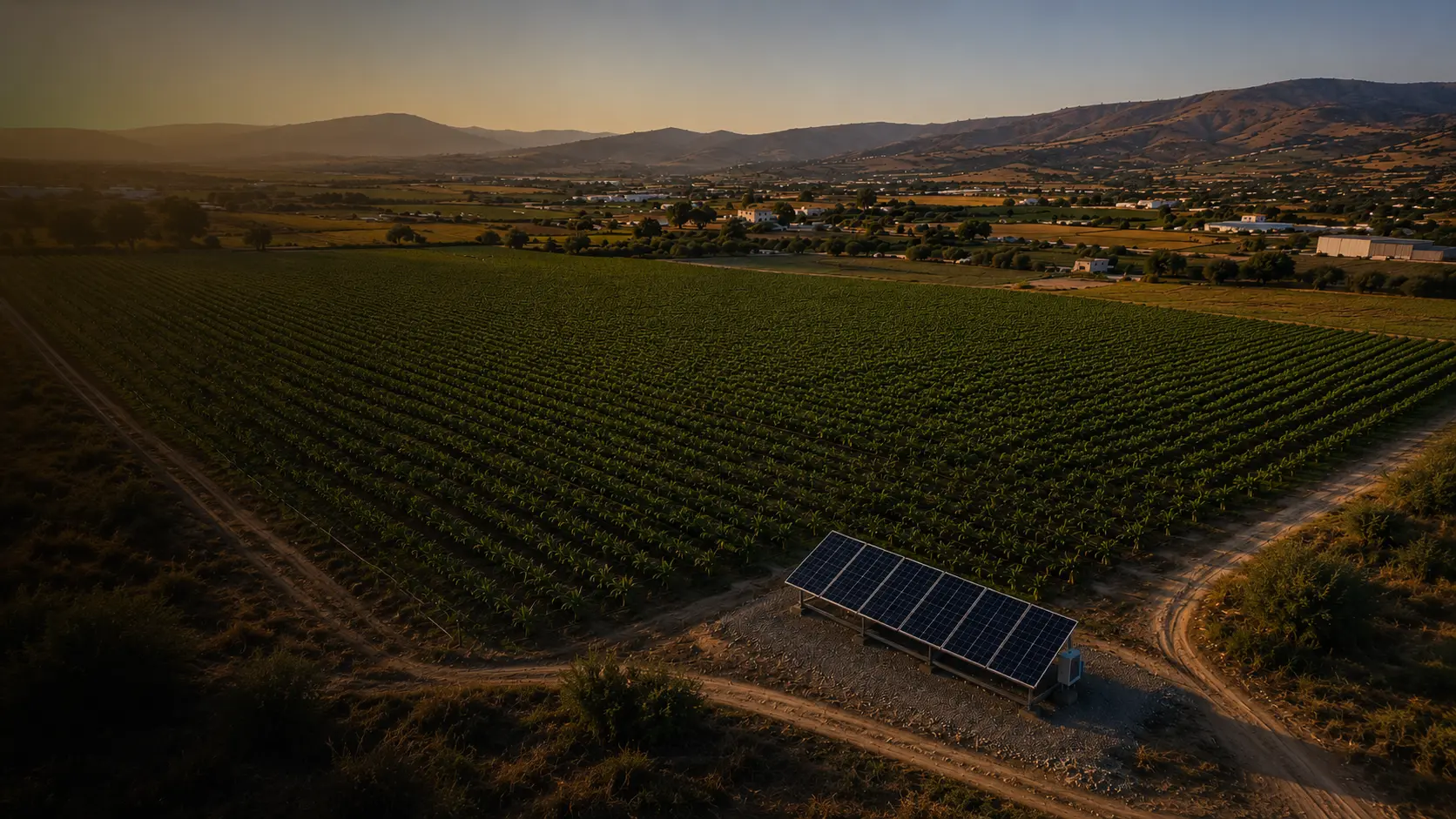
A solar array on a frame at the edge of an irrigated field in Cyprus at golden hour, with the valley and hills behind it.

Irrigation that runs on daylight

On irrigated land the pump is often the largest running cost there is, whether that cost arrives as diesel or as kilowatt hours. Panels beside the borehole do the same work in the same hours, and the fuel bill stops rather than shrinks.

Get your water pump offer

See what diesel irrigation really costs

  • 3 kW

    pump power

  • 6 hours a day

    during irrigation

  • 150 days

    per season

≈ 1,100 litres of dieselin one irrigation season

Illustrative example. Actual fuel use depends on the pump, engine and operating conditions, and this one assumes a small diesel engine doing about 2.5 kWh of work per litre.

For a small farm, irrigation can still mean hundreds of hours of diesel use every year. Solar can produce that energy right where the water is needed.

And that is only the fuel

ServicingRefuellingRepairsDowntime

Get your water pump offer
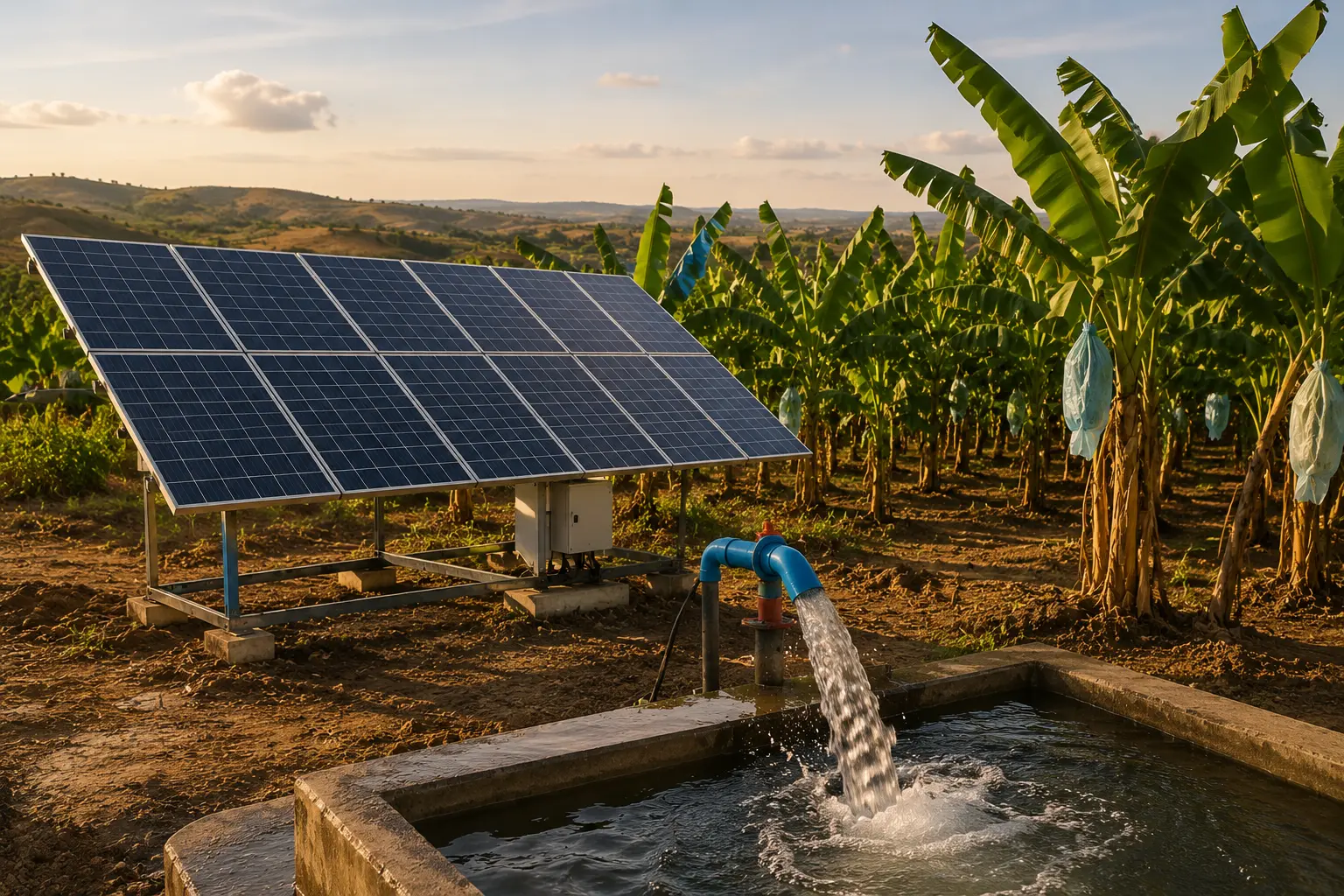
Ground-mounted solar panels with the controller beside them, feeding a pump that is filling an open concrete tank on a smallholding.

How solar powers your water pump

It is a simple system. Solar panels produce the electricity, a controller manages the power, and the pump moves the water. No grid connection or battery is needed for a typical setup.

  1. The panels produce the powerSolar panels are installed close to the pump or borehole.
  2. The controller manages itIt adjusts the power from the panels to what the pump needs.
  3. The pump moves the waterThe pump runs during daylight, with the strongest output when solar production is highest.
Get your water pump offer

Store water, not electricity

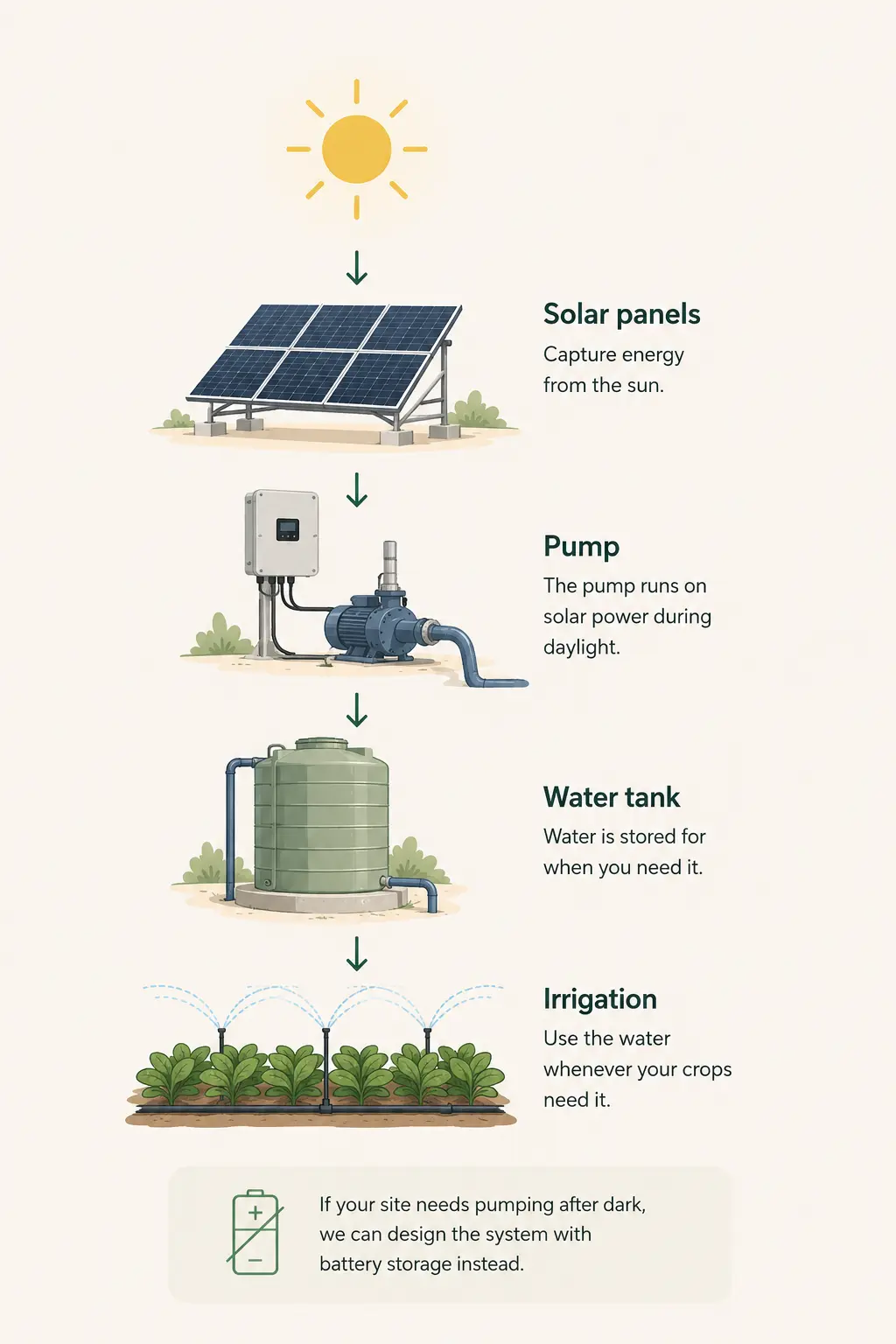
A diagram of the chain: the sun powers the panels, the panels run the pump, the pump fills a water tank, and the tank feeds the irrigation.

Pump water while the sun is shining and store it in a tank for when you need it. For many farms, that means there is no need for battery storage at all.

If your site needs pumping after dark, we can design the system with battery storage instead.

Questions we get asked first

I pump on diesel. Is it worth changing to solar?

Almost always, and the fuel is why. The engine costs you every hour it runs and it runs hardest in the months the crop needs the most water. Work out what your season burns in litres and you have most of the answer before anybody quotes you a price.

What the pumping costs now
Can I keep the diesel engine as a backup?

Yes. A hybrid controller runs the pump on the panels whenever there is light and hands over to the engine or the mains when there is not, so nothing is thrown away. On most sites a tank does the same job for less, which is the option we price first.

Tank against battery
Does a solar water pump need a battery?

Usually not. A tank filled during the day carries the irrigation past sunset for a fraction of what storing the same energy costs, and on many sites nothing is needed at all because the watering happens in daylight anyway.

Tank against battery
Can I keep the irrigation pump I already have?

Often, yes. An existing alternating current pump can be driven from panels through a solar drive, which is the cheaper route when the pump is sound. Where it is old or badly matched to the borehole, a direct current pump usually pays for itself in what it saves.

The two routes
What happens to the irrigation on a cloudy day?

The pump runs slower rather than stopping, so it moves less water rather than none. A run of dull days is what the tank is sized for.

Dull days and winter
Does a solar water pump need a grid connection or an EAC application?

Not where the panels feed the pump and nothing else. Nothing reaches the grid, so there is no export to apply for. We confirm what applies to your land at the survey.

How the system works
How deep can a solar water pump lift from?

Deeper than most boreholes on the island, but the honest answer is that depth, flow and distance together decide the design rather than any one of them. We measure all three before quoting.

What decides the size

Ready to stop buying fuel for the borehole?

Tell us what the pump runs on today, how deep the water is, whether there is a tank, and the schedule you actually keep. We will work out what the pumping needs, whether it can be done without storage at all, and what the fuel it replaces is costing you a year.

Get your water pump offer

If the pump you have is sound, we will price the drive before we price a new pump.

Solar water pumps, properly explained

Everything above answers whether this is for you. Below are the seven questions growers ask before they buy, in the order they usually come up.

1. Why does irrigation suit solar so well?

Because the water is needed in the season and the hours the panels are strongest, and because the job can wait an hour without anyone noticing.

The hard part of household solar is timing: a roof produces in the middle of the day and a family uses most of its electricity at either end of it. Irrigation does not have that problem. It is a job that has to happen for a certain number of hours, and it does not care which hours those are.

The season lines up as well as the day does. The months that ask the most of the irrigation are the months the sun is strongest, and the months that ask the least are the short ones. Very little else on a farm behaves like that.

  • The demand is in daylight and in the season the panels are strongest
  • The hours are yours to choose, which almost no other load allows
  • The result can be stored as water, which is cheap
  • The pump is often the largest single thing on the connection

Pumping is the rare load whose hours you choose, which is why it is the easiest one to put on your own production.

2. What is the pumping costing you now?

Whatever the fuel costs, multiplied by the hours you water. It is the figure that decides whether changing is worth it, and it is one you can work out yourself in a minute.

A borehole has three running costs: the fuel or the electricity, the servicing, and the time somebody spends going out to it. The first is the largest and the only one that grows with how much you water.

Start with what the pump draws. A modest borehole pump is a few kilowatts and a large one on deep water is more, and the plate on the motor will tell you. Multiply by the hours you run it in a day, then by the days you water in a year, and you have the energy your season needs.

If the pump runs on the meter, that figure is already in kilowatt hours and you can price it against your own bill. If it runs on an engine, divide by about two and a half. A small diesel engine turns roughly two and a half kilowatt hours of useful work out of a litre and the rest leaves as heat and noise, so a season of thirty thousand kilowatt hours is around twelve thousand litres. Multiply by what you actually pay at the pump.

That annual figure is what a solar system removes rather than reduces, and it is also what sets the payback: the cost of the system against a fuel bill that stops. Every quotation we write shows both, worked from your own hours rather than from an average, because a borehole that runs eight hours a day and one that runs two are not the same proposition.

  • The energy is what the pump draws, times the hours, times the days
  • A litre of diesel does about two and a half kilowatt hours of useful work
  • Servicing and the drive out are real costs that no receipt records
  • The fuel bill stops rather than shrinks, which is what makes the payback short

Work out your season once, in litres or in kilowatt hours. That single figure is the whole case for changing, and it is yours rather than ours.

3. How does a solar pump work?

Panels, a controller, and a motor. The controller takes the most the panels can give at any moment and passes it to the pump, and there is no inverter in the path.

The panels make direct current. An ordinary installation would convert it to the alternating current a building runs on, and that conversion is why an ordinary installation needs an inverter.

A solar pump either skips the conversion entirely, with a motor that runs on direct current, or uses a solar drive that makes what an existing motor expects. Either way the controller does the same job: it holds the panels at the point where they give the most power and sends it to the pump.

Which route is right depends on what is in the borehole today. A sound alternating current pump with a drive in front of it is the cheaper job; a direct current pump is more efficient and usually the better answer where the existing one was due for replacement anyway.

  1. 1

    The panels

    On a frame beside the borehole or the tank, where they can be cleaned.

  2. 2

    The controller

    Takes the most the panels can give at that moment and passes it on.

  3. 3

    The pump

    A direct current motor, or the pump you already have behind a solar drive.

  4. 4

    The tank

    Where the day's work is kept until the crop needs it.

No inverter in the path, and on most sites no battery and no connection.

The panels are wired to the pump rather than to a building. That is the whole system.

4. Should you store water or electricity?

Water, wherever the ground allows it. A tank does the same job as a battery for a fraction of the cost and nothing in it wears out.

Both answers carry the pumping past sunset. The difference is what you are paying to store: a cubic metre of water in a tank, or the energy it took to lift it, held in cells that have a life and a price.

The tank wins on almost every site that has somewhere to put one, and it wins by a wide margin. It also fails gracefully. A battery that ages gives you less every year; a tank that is too small simply means watering earlier in the day.

A battery is the right answer where there is no room or no height for a tank, or where something else on the same system needs power after dark. We price it when that is the case and not before.

Store the water. It is the same result in a much cheaper currency.

5. What decides the size?

Three numbers together: how far up the water has to come, how much of it you need, and how far it travels after that.

Head height is the first. Lifting water is most of the work a pump does, and a borehole twice as deep is roughly twice the energy for the same volume.

Flow is the second, and it comes from the crop and the schedule rather than from the pump's catalogue figure. The useful question is how many cubic metres a day the land needs in the heaviest month, not what the pump can do at its best point.

Distance and pipe size are the third, and the one most often left out of a quotation. Friction in a long run can cost as much as a few extra metres of depth, and it is cheaper to solve with pipe than with panels.

The exact numbers come from the survey. A quotation that has not asked for all three has guessed at least one of them.

Depth, volume and distance decide the system. A quote that names only the pump has answered a third of the question.

6. What happens on a dull day, and in winter?

It moves less water rather than none. The tank is what absorbs the difference, and winter asks far less of the irrigation in the first place.

A solar pump runs slower when the light drops rather than stopping. Slow pumping still fills a tank, and a tank sized for a run of dull days is what turns a variable supply into a reliable one.

The seasons help rather than hinder. The short days are the months the crop needs the least, and the long ones are the months it needs the most, so the two curves move together instead of against each other.

The weather changes how fast the tank fills, not whether the irrigation happens.

7. What should you ask before you buy?

Six questions that separate a system designed for your borehole from one sized off a price list.

  • What head, what flow and what distance did you design this against?

    All three, or the sizing is a guess. If only the pump model comes back, ask again.

  • How many cubic metres a day will this deliver in the heaviest month?

    That is the number your season depends on, and it is not the same as the pump's best point.

  • What is my current fuel bill for the same season, in litres?

    That is the figure the payback is built on. An installer who has not asked for it has worked the payback out from something other than your land.

  • Can my existing pump be used with a drive instead?

    An installer willing to quote the cheaper job first is one whose recommendations are worth more.

  • What size tank does this assume, and what happens without it?

    The tank is part of the design, not an accessory, and its size is what makes a dull week uneventful.

  • Who is responsible if the pump and the controller disagree?

    Two suppliers and one problem is the situation worth excluding before it exists.

Written to be read aloud at the kitchen table.

A good answer to any of these is about your borehole and your season. A general answer means the design is general too.

How we design every system

Ready to stop buying fuel for the borehole?

Tell us what the pump runs on today, how deep the water is, whether there is a tank, and the schedule you actually keep. We will work out what the pumping needs, whether it can be done without storage at all, and what the fuel it replaces is costing you a year.

Get your water pump offer

If the pump you have is sound, we will price the drive before we price a new pump.