The hottest hours of a Cyprus day are the sunniest ones. Cooling is the one large load on the island that peaks at exactly the time a roof is at its strongest.
The hottest hours of a Cyprus day are the sunniest ones. Cooling is the one large load on the island that peaks at exactly the time a roof is at its strongest.
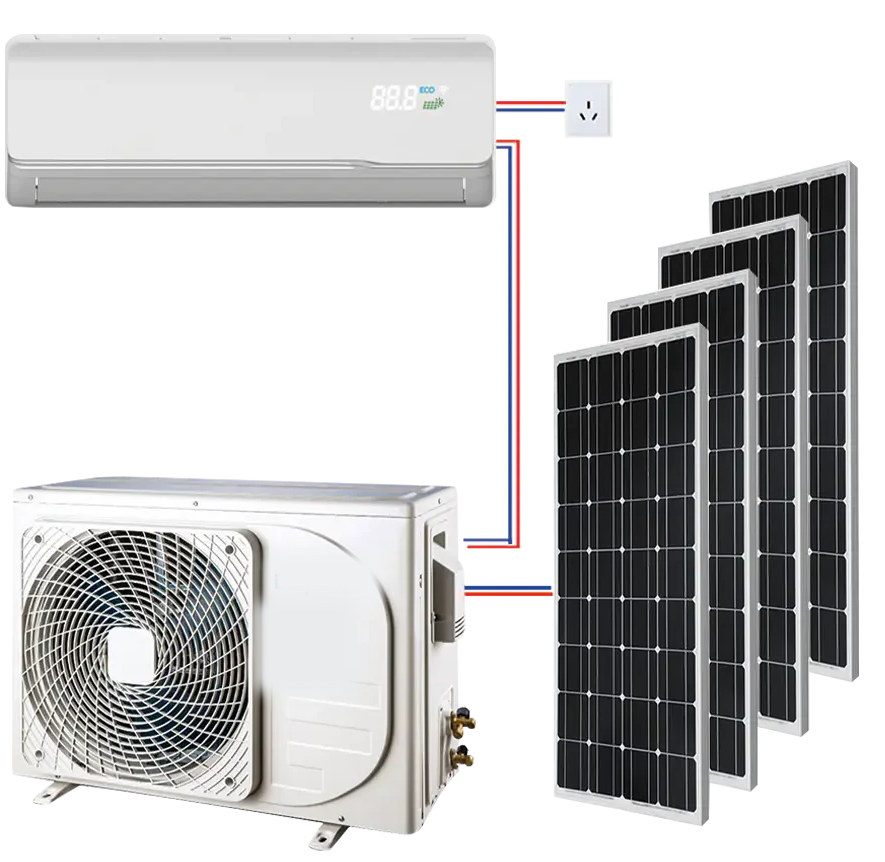
The system is simpler than it sounds. A few solar panels connect straight to the air conditioner through its built-in solar controller. No separate inverter, no batteries, no changes to your fuse box.
1The panels catch the sun.Two to three panels on the roof or a pergola are enough for one unit.
2The unit uses solar first.Whenever the sun is out, your cooling and heating run on your own power.
3The grid fills the gaps.At night and on grey days it works like any air conditioner. The switch is automatic and you never notice it.
€300 to €600a year of electricity the sun covers instead of the grid
A rough illustration rather than a quote. It assumes electricity at 0.30 per kWh, August 2026, and a unit running through the sunlit part of the day. What your own building would save depends on how it is used, and comes with the survey.
Whether it is your first air conditioner, a replacement, or an extra unit for a room that never got one, the maths is the same. Sunshine replaces grid power and the bill goes down from day one. The same unit heats in winter, on the same panels.
For shops, offices and restaurants the fit is even better. Business hours are sunshine hours, so the cooling you pay most for is exactly the cooling the sun covers.
No solar on the roof? It works on its own. Already have solar? Its own panels feed the unit directly and add to what you already save.
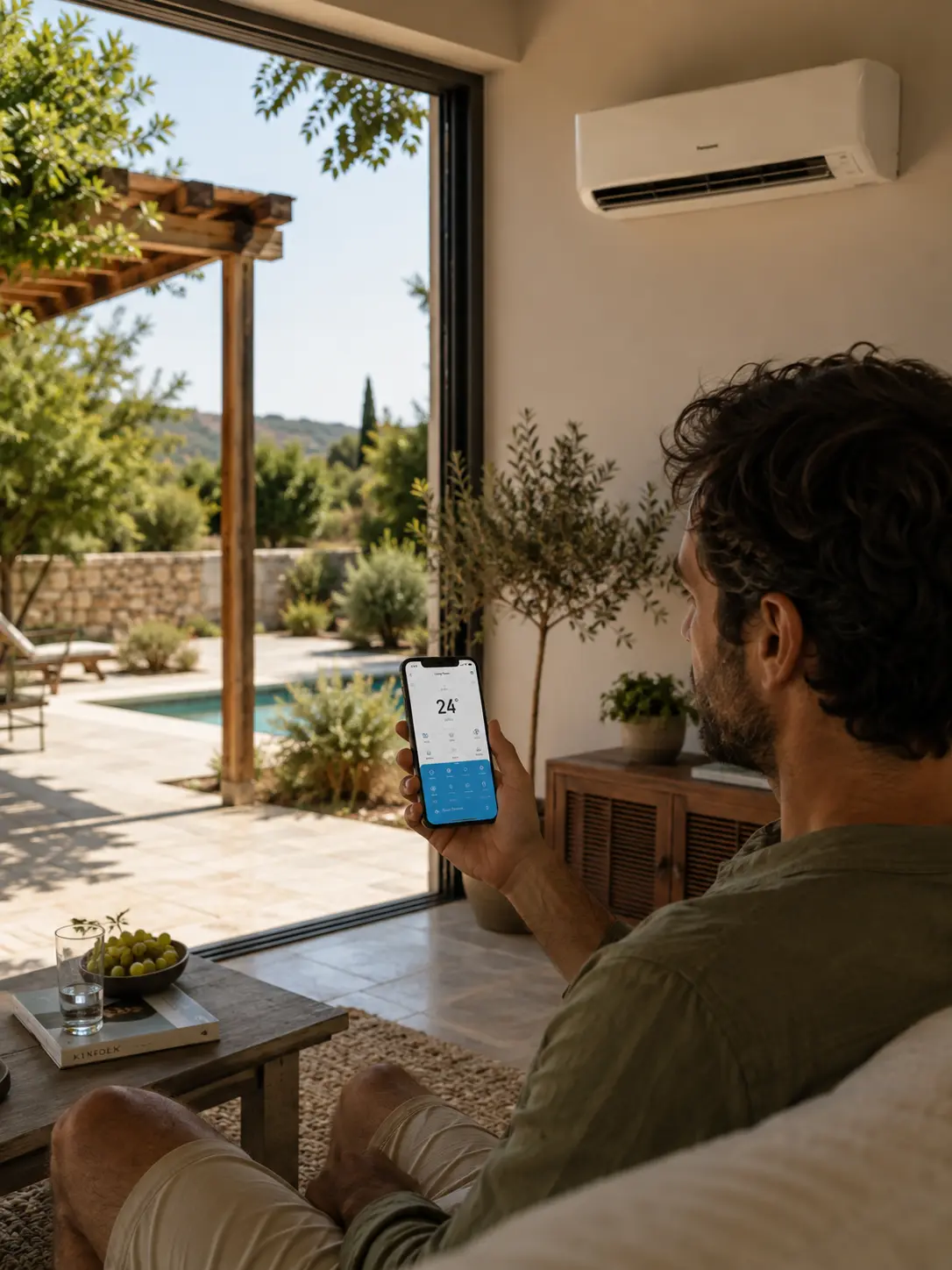
Set the temperature, build schedules and switch the unit on before you leave the office, so the house is cool when you walk in. The app also shows what the sun is covering right now, which turns out to be the screen everyone checks the first week and brags about the first summer.
Yes. The unit switches to grid power automatically when the sun goes down. During the day it runs on your panels, at night it works like a normal air conditioner.
Can I run the cooling from my existing solar system?
Often, yes. If your current system has spare production in the middle of the day, your existing AC can use it. A dedicated solar AC makes sense when your system is already fully used or cannot be expanded.
Will solar air conditioning cool the whole building?
One unit cools one room or open area. It comes in three sizes, from bedroom to open plan living room. For a whole house we combine units, and we size everything at the survey.
Tell us about the building and how it is used through the day, and we will work out whether a dedicated cooling system, a change to what you already have, or something else entirely is the right answer.
If the building would gain more from shading or from a better unit, we will tell you that first.
Solar air conditioning, properly explained
Everything above answers whether this is for you. Below are the nine questions people ask before they buy, in the order they usually come up.
1. Why does solar air conditioning suit Cyprus?
Because the hottest hours are the sunniest ones. Your heaviest load and your strongest production land at the same time of day, which is unusual and is what makes the sums work here.
Solar is hardest to justify where demand and production are out of step. A northern European household wants its electricity when the roof has nothing to give, so a great deal of engineering goes into moving it across time.
Cooling is the opposite case. The hotter it is, the more cooling a building wants, and the hotter it is the more the sun is doing what a roof needs. The two curves rise together and fall together.
What the roof makes
When the building wants cooling
Where they meet
The shaded overlap is what you avoid buying. Cooling puts more of a Cyprus day inside it than any other load.
Cooling is the reason solar economics work better here than in most of Europe, and it is the reason before any equipment is chosen.
Because cooling is concentrated. It arrives in a few months of the year, and inside those months in a few hours of each day.
A household bill across a Cyprus year has a shape, and the shape is summer. That is why cooling is worth treating on its own rather than as part of the general electricity conversation.
The concentration is also what makes it addressable. A load spread thinly across the year and the night is hard to move. A load that arrives at a known hour in a known season can be designed around.
The load is seasonal, which means a system can be sized against that season
It is also daily, arriving in the hours production is strongest
It is predictable enough to design for rather than to guess at
It is the part of the bill most households would most like to change
A predictable load at a predictable hour is the easiest kind to put on your own production.
3. How does a solar air conditioner work?
The panels are wired straight to the unit, through a controller built into it. There is no separate inverter, no battery, and nothing changes in your fuse box.
A conventional solar installation makes direct current on the roof and converts it to the alternating current a building runs on. That conversion is what lets everything in the house use it, and it is also why the installation touches the whole building.
A solar air conditioner shortens the path. Its compressor runs on direct current already, so the panels go to the unit through a controller inside it and the conversion step is left out. The controller holds the panels at the point where they give the most and takes whatever that is at any moment.
The grid stays connected as the second supply. When the panels carry the whole load, the unit runs on them. When they carry part of it, the unit tops up from the grid. When they carry none of it, it works like any other air conditioner. The changeover is automatic and you do not set it.
Two things follow from that. The building's wiring is untouched, because nothing new feeds it: the panels reach the unit and stop there. And nothing this system makes can travel out to the meter, which is why a new export application is usually not part of the job. We confirm what applies to your property before we quote it.
One more thing worth knowing. The unit varies its output rather than switching between full and nothing. It works hard to bring a room down, then runs gently to hold it there, which is what lets it follow the panels through the day.
The panels are wired to the machine rather than to the building. That single difference is where the simplicity comes from, and most of the paperwork you avoid.
4. Does it work during a power cut?
Yes, in off-grid mode, for as long as the sun is on the panels. It covers that one unit and the rooms it serves, and not the rest of the building.
A rooftop system connected to the grid disconnects when the grid fails, by design and by regulation, so that it cannot feed a line somebody may be working on. That is why a house with panels goes dark with the rest of the street unless it has been built for backup.
A unit fed by its own panels is outside that rule, because nothing it produces reaches the grid in the first place. In off-grid mode the cooling keeps running on sunlight while the neighbourhood is out.
It runs one unit and the rooms that unit serves
It runs while the sun is on the panels, and not after dark
Nothing else in the building is connected to those panels
The case it answers is an outage on a hot afternoon, which is the common one
Cooling that survives an afternoon outage, in the hours an outage is hardest to sit through.
5. Does it heat the house in winter?
Yes. The same unit reverses and heats, on the same panels, with nothing added to the installation and nothing to do beyond changing the mode.
In winter the unit moves heat into the room instead of out of it. It is the same machine and the same panels, used the other way round.
A mild winter is where this kind of heating is at its best. Moving heat costs less the smaller the difference between outside and the room, so the same equipment that struggles in a northern January works comfortably in a Cyprus one.
The days are shorter and the sun is lower, so the panels cover less of the day. What they cover is the middle of it, which suits a building warmed while it is being used and a house brought up to temperature before the evening.
One machine covers both ends of the calendar, which makes the case for it stronger than a cooling calculation alone would show.
6. What size system does your building need?
It follows from the rooms rather than the floor area. Often the load is worth reducing before anything is sized, and that costs less than the equipment would.
How much cooling a building needs is not a fixed property of its floor area. It comes from the glazing, the shading, the insulation, the orientation and how the space is used through the day.
That matters commercially as well as technically. A building whose load can be reduced first needs a smaller system to cover the rest, and the reduction usually costs less than the system would have.
We would rather size a system against a building that has already dealt with the obvious than sell a larger one to cool a room through an unshaded window.
Shading on the glazing that takes the afternoon sun
How much heat the building holds after dark
Which rooms are actually occupied through the day
Whether the units in place are matched to the spaces they serve
Reduce the load, then size the system. Doing it in the other order is how buildings end up with more equipment than they needed.
7. Can your existing solar system run it instead?
Often yes, if the roof still makes more than the building uses at midday. Where it does not, a unit with its own panels is the way in.
If there is already solar on the roof, the first thing to establish is whether the building uses everything it makes in the middle of the day. Where it does not, running the cooling you already own on that surplus is the cheapest good answer available, and it is a change to habits and settings rather than a purchase. We will say so when we find it.
Where the existing system is fully committed, or where the connection, the phase or the roof will not allow it to grow, a unit with its own panels is a way forward that leaves the installation you already have alone.
The two also sit together. A unit that brings its own panels adds production to the property instead of competing for what is there, so a house whose system is already fully used still gains from one. What it does not do is take capacity away from the rest of the building.
1
Do you already have a solar system?
No A dedicated cooling system stands on its own and can be sized against the summer.
Yes
2
Does it still produce more than the building uses at midday?
No A dedicated system, so the cooling and the building are not drawing on the same capacity.
Yes
3
Can it be extended without changing the connection?
No A dedicated system, which is what this route exists for.
Yes
Use the production you already have
The simplest answer, and the one we will point you to whenever it is available.
Three questions, and the first no is your answer.
A limit on the existing installation is the strongest argument for a unit with its own panels, rather than a reason to stop.
8. What about cooling at night?
At night the unit runs on the grid, like any air conditioner. A system fed by panels works while the sun is up, and the evening is a separate question.
Bedrooms are cooled at night, and no amount of framing makes that a daytime load. Saying otherwise would be the kind of claim that falls apart on the first warm night.
So it is worth splitting the two. The daytime cooling, which is most of the load in an occupied house or a working building, is what a solar cooling system is for. The night-time part is where storage or the grid comes in, and whether that is worth paying for is a household question.
A useful way to look at it: solve the large predictable daytime load first, then decide whether the smaller evening one is worth solving separately.
Daytime cooling is what this answers. Night-time cooling is a storage conversation, and a different one.
Tell us about the building and how it is used through the day, and we will work out whether a dedicated cooling system, a change to what you already have, or something else entirely is the right answer.