
Skip to content
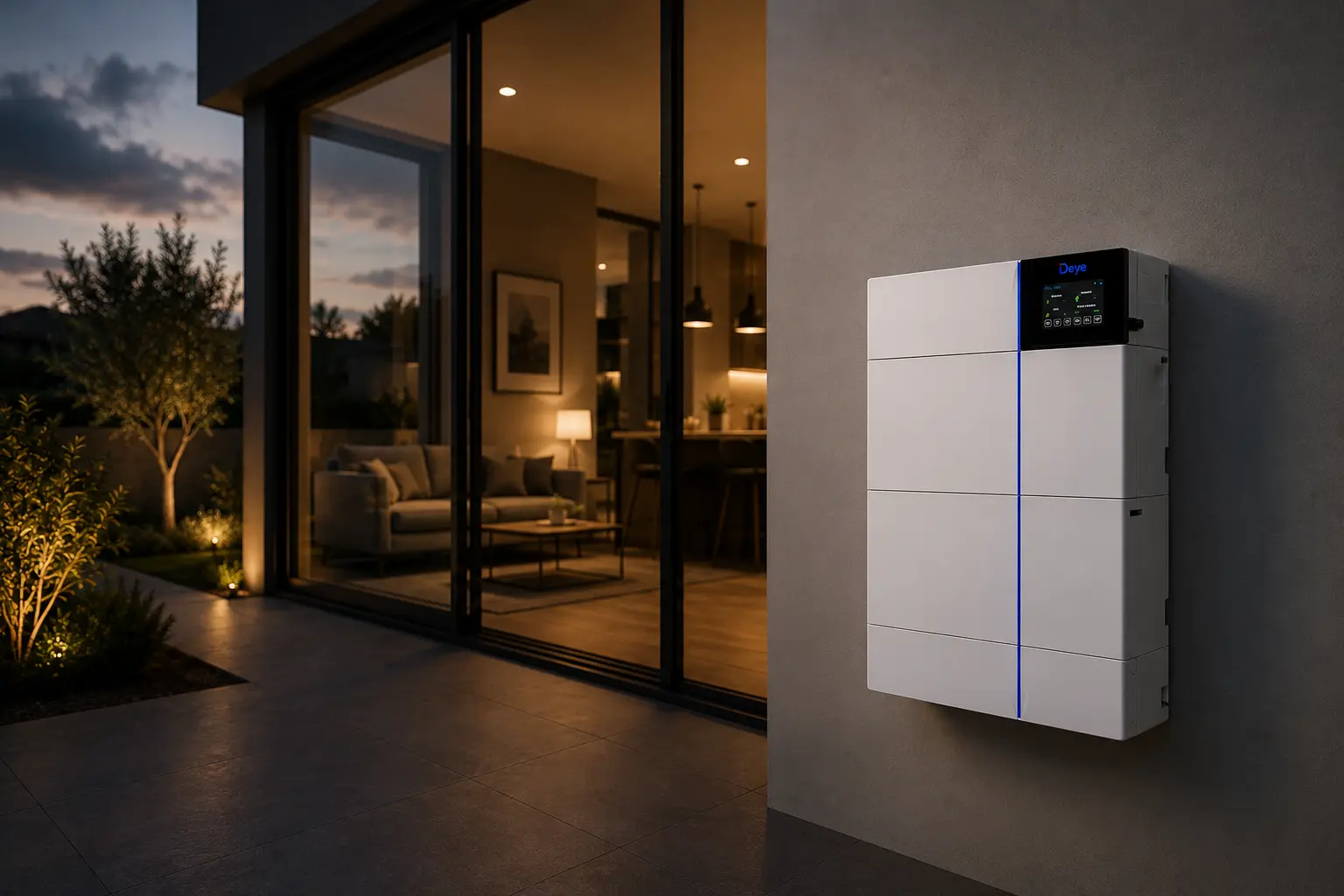
A home battery mounted on the wall of a house at dusk, with the living room lit inside.

Store today's sunshine
Use it tonight

At midday your roof makes more than the house can use. A battery keeps the rest for the evening, instead of selling it cheap.

Get your battery offer

How much of your own electricity could you keep?

Three questions, and you know all three answers. The green band is what you use yourself.

It is on your quote as the yearly production. If the panels are already up, your inverter app shows it.

Is anyone home during the day?

How many batteries?10.24 kWh

One battery holds about 5 kWh. Drag through the numbers to compare.

Your usage today, with no battery

40%

With a battery

74%

  • You use it straight away3,200 kWh
  • Saved for later2,990 kWh
  • Sold to the grid1,810 kWh

A battery keeps 2,690 kWh a year that you are selling cheaply today. You go from using 40% of your own electricity to 74%.

You stop buying
2,690 kWh
That is worth
410–550 EUR

A range, on purpose. What a battery is worth depends on when your house actually uses electricity, and nobody can know that before looking at your meter.

Your roof works hardest in the middle of the day, when most houses are empty. What you cannot use then goes to the grid, and you buy it back at three times the price after dark.

That gap is why batteries exist. A battery makes no extra electricity. It holds your midday until the evening, when the cooking and the air conditioning start.

Being home during the day matters more than people think, and the other way round: if you are in, you are already using the midday peak, so there is less left for a battery.

Get your battery offer

How we choose our battery systems

We believe choosing the right battery is about much more than capacity.

Every system we install has to meet our standards for safety, reliability and long-term performance before we recommend it to a homeowner.

Safety comes first

A home battery should be something you never have to worry about.

That's why safety is always our first priority. We only work with battery systems that meet strict safety standards and are designed for everyday use in family homes.

Easy to expand

Your home may change over time.

You might buy an electric car, add a pool pump or simply use more electricity than you do today.

We prefer battery systems that can grow with your needs instead of forcing you to replace everything.

Backup when you need it

Not everyone needs backup power.

But if you do, your battery system should be able to support it.

We choose systems that can be configured for backup when the installation is designed for it.

Easy to understand

You should always know how your system is performing.

We choose batteries with clear monitoring so you can see how much electricity you produce, store and use every day.

Built to work together

A battery and an inverter should work as one system.

That makes installation simpler, troubleshooting easier and support much more straightforward if you ever need help.

Reliable for the long term

A battery is a long-term investment.

We choose manufacturers with a proven track record, long warranties and products we trust to perform for many years.

Local support matters

If something ever needs attention, help should be close by.

We work with manufacturers that have established support and spare parts available for the Cyprus market.

Proven in real homes

We don't choose products because they look good on paper.

We choose systems that have performed well in real installations and continue to deliver year after year.

Questions we get asked first

Do I actually need a battery?

No, and plenty of good systems do not have one. A battery earns its keep when you produce more during the day than you use and what you are credited for exporting sits well below what you pay to buy back. Both of those are true for most Cyprus households, which is why it is worth checking rather than assuming.

Can I add storage later rather than now?

Yes, if the system was specified for it. We fit hybrid inverters as standard for exactly this reason, so adding storage later is a battery and a day's work rather than replacing the inverter you already paid for. Ask any installer whether their quote leaves that door open.

Adding storage later
What size battery do I need?

Enough to catch the surplus you actually have, which is usually smaller than people expect. Sizing to your biggest summer day buys capacity that sits empty for eight months. The calculator above shows the point where another unit stops having anything left to store.

What decides the size
Does a battery keep the house running in a power cut?

Only if the system has been built for it. A battery on its own does not keep the lights on: that needs an inverter with a backup output and a separate circuit wired to it, decided before installation rather than after. Tell us if it matters to you and we will quote it that way.

How backup works
Does storage make sense under Cyprus net billing?

Yes. Under net billing the electricity you send to the grid earns the export rate, while the electricity you buy back costs the full retail price. A battery lets you keep more of your own production and use it in the evening, which is where the distance between those two values turns into money on your bill.

Net billing explained
Can I have a battery without solar panels?

Technically yes, and it rarely pays. Without production the battery has nothing to store except grid electricity bought at one time of day and used at another, and Cyprus domestic tariffs do not have the price difference that would make that worthwhile. Storage earns its keep alongside a roof that is producing more than the house uses during the day.

Store today's sunshine

Use more of the electricity your roof already produces. We will help you understand how much energy your home can store, what battery size makes sense and whether battery storage is the right investment for your property.

Get your battery offer

If battery storage is not the right investment for your home, we will tell you.

The battery storage guide

Everything above answers whether storage is for you. What follows is the whole subject, from what a battery physically does to how the sizing and the economics actually work. It is here for the reader who wants to understand it properly before deciding.

1. What a battery actually does

It does not make electricity. It moves electricity from the hour it was made to the hour you need it.

Hold on to that sentence, because it is the idea everything else here rests on. A battery adds nothing to your annual production. A roof that makes 8,000 kWh makes 8,000 kWh with storage and without it.

What changes is where those units go. Without storage, anything your house cannot use at the moment it is made goes to the grid. With storage, some of it waits in a box on your wall until the evening and then runs your lights, your cooking and your air conditioning.

So the value of a battery comes entirely from the difference between what a unit is worth at the hour it was made and what it is worth at the hour it is used. Chapter eight puts numbers on that, including the small share that is lost on the way in and out.

A battery moves it across6amMidday6pmMidnight
  • When the roof produces
  • When the house uses most
The battery does not make the block on the left any bigger. It carries part of it across to the right.

A battery changes when you use your electricity, not how much of it your roof produces.

2. Why homeowners install storage

Four reasons, and they are not four ways of saying the same thing. Each one holds on its own.

Which of these matters most is different from one household to the next, and it is worth knowing which one is yours before you look at sizes. They do not all point at the same battery.

  1. 1

    Use more of your own solar electricity: A good deal of what a rooftop makes arrives at hours when the house is quiet. Storage is how that share gets used at home instead.

  2. 2

    Buy less electricity from the grid: Every unit that comes back out of the battery in the evening is a unit you do not purchase. This is the one that shows up on a bill.

  3. 3

    Depend on the grid a little less: A house running its evening on its own afternoon leans on the network for a smaller share of the day.

  4. 4

    Reduce exposure to future price changes: The share of your electricity you generate and keep is priced by equipment you have already paid for.

Storage answers four different questions. Knowing which one is yours makes every later decision easier.

3. Self-consumption, and why your electricity leaves

Production peaks at midday. A household does not. The distance between those two shapes is the surplus a battery can work with.

A rooftop system produces on a curve: nothing before dawn, a peak around midday, nothing after dusk. A house consumes on a different one. A small rise in the morning, less through the middle of the day, and a long evening peak that starts about the time production stops.

Lay the two curves over each other and the overlap is electricity you use as it is generated. Everything under the production curve and outside that overlap goes to the grid. Self-consumption is the name for the share you use yourself, and raising it is what a battery is for.

How large that share is before any battery is added varies a great deal from one property to another. Daytime occupancy, air conditioning, a pool pump, EV charging, the size of the array and the household's total consumption all move it, and so does the season.

MorningMiddayEvening
  • What the roof produces
  • What the house uses
  • Used as it is generated
Production peaks at midday and household demand does not. The shaded overlap is electricity used as it is generated.
Illustrative householdThe household this guide follows
Annual solar production
8,000 kWh
Occupancy
Away on weekdays
Assumed used as generated, before storage
40%, or 3,200 kWh
Surplus available to store
4,800 kWh

An illustrative household, not a Cyprus average. The 40% is an assumption chosen because it shows the timing mismatch storage is designed for. Your own share could be substantially higher or lower. The calculator above works it out from your figures.

Self-consumption is the share of your own production you use yourself, and it is the number storage is designed to raise.

4. Does storage make sense under Cyprus net billing?

Under Cyprus net billing, using more of your own solar electricity can significantly increase the value your system returns.

Under net billing the electricity your system sends to the grid and the electricity you buy from it are valued differently. Exported units earn the export rate. Imported units cost the full retail price.

Storage works in the space between those two. Electricity that would have gone to the grid can be kept and used by the household later the same day, which turns an exported unit into one you never had to buy.

That is one of the main sources of a battery's value in Cyprus. The table below is the whole idea in three rows.

Used as it is generatedWhat it is worth to you0.30WhyThe retail price you did not pay
Sent to the gridWhat it is worth to you0.11WhyThe export rate
Stored, then used in the eveningWhat it is worth to you0.19WhyThe retail price avoided, less the export rate given up
Example assumptions used throughout this guide. Retail electricity 0.30 per kWh all in, export value 0.11 per kWh. Reference date August 2026. Both can change, and the export rate is set by policy rather than by a market, so treat the principle as the durable part rather than the figures.

The more of your own solar you use rather than export, the more value your system returns under net billing.

5. What size battery do you actually need?

Size storage around the electricity that is genuinely available to store and useful later, rather than around the size of the solar array.

A bigger battery is not automatically a better battery. What decides the right size is not how many kilowatt-hours the roof makes in a year, but how much of it is spare at the moment it is made and how much of that the household can use after dark.

Annual production alone cannot answer that, which is why this chapter explains what goes into the decision rather than handing you a number. Two houses with the same array and the same annual figure can want very different storage.

What actually decides the size:

  1. 1

    The surplus on individual days: Not the annual total. A battery works with what is spare on a given afternoon.

  2. 2

    Evening and overnight consumption: Storage can only deliver into demand that is there. A large battery in a house with a quiet evening has nowhere to put what it saved.

  3. 3

    Seasonal variation: Cyprus production changes through the year, so the electricity available to charge a battery changes with it.

  4. 4

    Usable capacity and efficiency: The rated size is not all usable, and a little is lost converting in and out.

  5. 5

    How often the extra capacity would be used: The last unit in a stack is the one used on the fewest days, and it costs the same as the first.

Summer

Long days and a large daytime surplus. The battery fills readily and often has more available than it can hold.

What that means for sizing: extra capacity is used on these days, so summer alone will always argue for a bigger battery.

Spring and autumn

A moderate surplus, and a battery that charges and discharges through a full cycle most days.

What that means for sizing: usually the most useful period to size around, because capacity is neither wasted nor short.

Winter

Lower production and a smaller surplus. A large battery can spend much of the season partly empty.

What that means for sizing: capacity bought for summer sits unused here, which is what makes over-sizing expensive.

The same battery behaves differently across the year, which is why an annual average is a poor guide to the right size.
5.12 kWhRoughly where it fitsA smaller evening load, or a household that already uses much of its production during the day.What to checkIs the evening demand there to empty it?
10.24 kWhRoughly where it fitsMore evening consumption, or a larger daytime surplus to work with.What to checkDoes the surplus reach this size outside summer?
15.36 kWhRoughly where it fitsHigher household loads and properties where a substantial surplus is regularly available.What to checkHow many days a year would the top of it actually be used?
The modular sizes NorthWatt fits, shown as options rather than as recommendations. Which one suits a property depends on the factors above, not on annual production alone.

The best battery is not the one that catches every surplus unit on the sunniest day. It is the one whose capacity gets used often enough across the year to be worth buying.

6. Does storage work during a power cut?

It can, when the system is designed for it. Backup is something you specify rather than something every battery brings with it.

A standard grid-connected system shuts down when the grid goes down, battery or not. That is a safety requirement rather than a shortcoming: it stops your system feeding a line somebody may be working on.

Backup is designed in on purpose, and there is more than one way to do it. Some installations carry a set of essential circuits, which is the simplest and least expensive approach. Others can support a much larger part of the home. What is possible depends on the inverter, the battery, the electrical installation, whether the supply is single or three phase, and how much backup power the household wants.

It is worth knowing what happens to the panels too. In a standard system they stop with everything else. In a correctly designed hybrid backup system the solar can, in some configurations, keep supplying the house and charging the battery while the grid is away, which turns a long outage into something a household can live through rather than wait out.

High-power appliances are the part to think about in advance. Air conditioning, an oven or a pump draws heavily and can exceed the backup output of a smaller system, and it will empty a battery faster than lighting and a fridge. Whether a particular appliance can run comes down to the inverter's backup power, the battery's discharge power, the appliance's starting load and what else is on at the time.

If riding out a cut matters to you, say so before anyone quotes. It is a design decision, and it is much easier to build in than to add afterwards.

  1. 1

    Does the inverter have a backup output?

    No The system shuts down with the grid, battery or not. This is where most standard installations stop.

    Yes, keep going

  2. 2

    Is a backup circuit wired to that output?

    No The battery holds energy and nothing in the house is connected to draw it.

    Yes, keep going

  3. 3

    Do you know which circuits and appliances are on it?

    No You find out during the cut, which is the wrong time to find out.

    Yes, keep going

  4. The house keeps running on its own electricity

    The circuits you chose stay live, and in some configurations the panels keep producing and recharging the battery while the grid is away.

Three things have to be in place. Any one of them missing and the system behaves like a standard grid-connected installation when the power goes.

Backup is a design choice worth making early. Ask for it before the quote and you can have it.

7. Can you add storage later?

Yes. How straightforward it is depends on what the original system was designed to accept.

Plenty of good systems start without a battery, and adding one later is a normal thing to do. The question is what it takes when the time comes, and that is largely settled by the equipment already on the wall.

A hybrid inverter has the battery connection built in, so adding storage later is a battery, a morning of work and a commissioning check. Where the original inverter has no battery connection, storage can still be added through an AC-coupled solution, which puts a second piece of equipment alongside the existing one rather than replacing it. That works well and is slightly less efficient than a system designed for storage from the start, because the electricity is converted an extra time on its way in.

NorthWatt generally specifies hybrid inverters, and future flexibility is one of the reasons we prefer them. A homeowner who adds a battery three years later should not have to redesign the solar system to do it.

It is a fair question to put to any installer, in these words: if I add a battery in three years, what would have to change?

There is one case where storage is specified from the start for a different reason. Where the network will not accept exported electricity, a zero export system holds production back to what the property itself can use, and a battery is what turns the surplus it would otherwise waste into something the house has later.

Year 1Year 2Year 3Year 4Year 5

Designed for storage

Panels and hybrid inverter

Battery connects

One addition. A morning of work and a commissioning check.

Not designed for storage

Panels and inverter

Battery plus added equipment

Still possible through an AC-coupled solution, with an extra piece of equipment and a small efficiency cost.

The same five years, twice. Both paths end with storage. They differ in what has to be added to get there.

A system designed with storage in mind keeps the door open, which is why we generally fit hybrid inverters.

8. How storage actually saves money

The value of a stored unit is the grid electricity it avoids, less the export value given up to store it.

This is the part worth understanding properly, because it is where quotes differ most. Storing a kilowatt-hour does not earn you the full retail price. That unit would have earned the export rate if you had let it go, so the honest figure is what you avoid paying minus what you gave up receiving.

There is a second thing to account for. A kilowatt-hour put into a battery is not quite a kilowatt-hour taken back out: converting in and out costs a little, and around 90% coming back is a reasonable figure for a modern home battery on a hybrid inverter. The arithmetic below carries both, which is what makes it match a real bill.

The result is a straightforward calculation with nothing hidden in it, and one you can run against any quote you are given.

Without storage

Used as generated
3,200 kWh
Exported
4,800 kWh

With storage, illustrative

Used as generated
3,200 kWh
Into the battery
3,000 kWh
Exported
1,800 kWh
The illustrative household's 8,000 kWh, before and after. Nothing was added. Electricity moved from the export column into the household's own use.
Illustrative householdThe arithmetic, on stated assumptions
Assumed captured by the battery over a year
3,000 kWh
Delivered back to the house at 90% round trip
2,700 kWh
Retail electricity avoided, at 0.30
810
Export value given up, on 3,000 kWh at 0.11
330
Net value in a year
about 480

A calculated output from the assumptions stated above and in chapter three, not a measured result from a NorthWatt installation. What a battery captures depends on when a particular household uses electricity. The calculator above estimates it from your own figures.

A stored unit earns the gap between the retail price and the export rate, on the energy that comes back out.

9. Energy independence in everyday life

More control over where your electricity comes from and when you use it, rather than leaving the grid behind.

A grid-connected home stays connected, and that is a good thing: the network is there for the evenings a battery cannot cover and the weeks when production is low. What storage changes is the proportion.

Electricity generated in the afternoon and used at eight in the evening is electricity the household did not buy. Do that most days of the year and a meaningful share of the evening runs on the roof rather than on the network.

That is the everyday version of energy independence, and it is the one that shows up in a bill. Store today's sunshine, and use more of it yourself.

Without storage

100%of the evening bought from the grid

  • From this afternoon's sunshine

    0%

  • Bought from the grid

    100%

With storage

55%of the evening bought from the grid

  • From this afternoon's sunshine

    45%

  • Bought from the grid

    55%

The illustrative household's evening, with the same two rows in both so the change is one line. The connection is there either way.
Illustrative householdWhere those shares come from
Assumed used outside production hours
about 6,000 kWh a year
Delivered by the battery, from chapter eight
2,700 kWh
Share of the evening covered
about 45%

Calculated from the illustrative household's stated assumptions. A household with a different evening pattern will land somewhere else.

Energy independence here means a larger share of your evening running on electricity you generated yourself.

10. Storage and future electricity prices

The more of your electricity you generate and keep, the less of your bill moves with the retail price.

Nobody can tell you what electricity will cost in Cyprus in ten years, and this chapter does not try. What can be said is which part of a bill is exposed to the answer. Electricity you generate and use yourself is priced by an installation you have already bought. Electricity you import is priced by whatever the retail price is that year.

That is why a rising electricity price shortens the payback on solar and storage rather than lengthening it. The value of the system is measured in units of the thing that is getting more expensive.

The same reasoning applies to the export rate, in the other direction. It is set by policy rather than by a market, so a household that keeps more of its own production is less exposed to changes in either number.

Illustrative householdThe same figures if electricity cost more
Net value of the shift today
about 480 a year
If retail electricity were 20% higher
about 640 a year
What changed on the roof
nothing

Arithmetic on one stated assumption, using the same 2,700 kWh delivered and 3,000 kWh captured as chapter eight. It is here to show the direction rather than to predict a price.

The share of your electricity you generate and keep is the share that stops moving with the retail price.

11. Choosing the right battery system

You do not have to become an engineer to choose well. This is the evaluation we run before a battery reaches a quote.

There are a great many home batteries on the market and most of them work. The useful question is not which is best in the abstract, but which behaves well on a Cyprus roof, in a Cyprus summer, in a house whose evening starts at seven. That is the part we have already done.

The systems that come through it well share three things a homeowner benefits from later. Capacity that can grow. A battery and inverter designed to work together. Monitoring that makes it obvious when the system is doing its job.

The table below is what we look at, in the order we look at it, with what each line changes for the household rather than what it says on a datasheet. It is here so you can see the reasoning, not so you have to repeat it.

Usable capacityWhat it changes for your homeThe rated figure is not all available. Usable capacity is what the household actually gets to cycle.What we ask of itHow many kWh are usable rather than rated?
Charge and discharge powerWhat it changes for your homeDecides how fast the battery can absorb a midday peak and how much of the house it can run at once.What we ask of itWhat is the continuous power, in kW?
Backup capabilityWhat it changes for your homeWhether the system can supply the home during an outage, and how much of it.What we ask of itWhat does backup cover, and at what power?
ExpandabilityWhat it changes for your homeA system that takes another module later can follow a household whose consumption changes.What we ask of itCan I add capacity in two years?
Warranty and chemistryWhat it changes for your homeLithium storage is warranted in cycles and retained capacity, which says more than a headline number of years.What we ask of itWhat capacity is guaranteed, after how many cycles?
Operating conditionsWhat it changes for your homeCyprus summers are hot, and temperature affects both output and life.What we ask of itWhat temperature range is it rated for?
Inverter compatibilityWhat it changes for your homeBattery and inverter from one ecosystem means one company answers if something does not work together.What we ask of itWhose warranty covers the pair?
MonitoringWhat it changes for your homeA system you can see the behaviour of is one you can tell is working as intended.What we ask of itWhat does the app actually show?

Figures needed. Usable capacities, continuous power, warranty terms and cycle counts for the systems we fit, with the datasheet date for each. Kept here for the quotation rather than for the page: manufacturers are deliberately not named on the pillar pages.

We narrow the field to systems we would fit in our own homes, so the choice you are left with is about your property rather than about the market.

12. The questions that come up last

The practical ones, once the principle is settled. Sizing, backup, net billing and adding later each have a chapter of their own above.

How much space does a home battery need?

A single 5.12 kWh module is roughly the footprint of a small suitcase against a wall, and a stack of two or three is taller rather than wider. What usually decides the position is not floor space but ventilation, a shaded wall and a short run to the inverter. We pick the spot during the survey.

How long does a home battery last?

Lithium storage is rated in cycles rather than years, and a home battery does roughly one cycle a day. Manufacturers guarantee a share of the original capacity after a stated number of cycles, and that pair of numbers is the useful comparison rather than a headline lifetime.

Where does a home battery get installed?

Usually on a wall in a garage, a plant room or a shaded exterior wall, close to the inverter. It needs ventilation and it does not want direct afternoon sun, which in Cyprus rules out more walls than people expect.

Does a home battery need maintenance?

There is nothing to service annually. What it does benefit from is somebody glancing at the monitoring now and then, because a battery that has quietly stopped cycling looks much like one that is working until you check.

Is a home battery safe indoors?

Home storage sold in the EU is built to standards that cover exactly this, and the chemistry used in home units is among the more stable available. Installation matters as much as the product: ventilation, mounting and the protection around it are part of the job.

Does a home battery make noise?

The battery itself is silent. The inverter has a fan and a faint hum under load, which is why neither belongs on the other side of a bedroom wall.

What happens to a home battery at the end of its life?

It is covered by the EU battery regulations, which place the obligation to take it back on the producer. In practice you contact whoever supplied it. It is worth confirming in writing for the specific make before you buy.

If a question you have is not answered here or above, it is a good one to put to us before you buy.

Store today's sunshine

Use more of the electricity your roof already produces. We will help you understand how much energy your home can store, what battery size makes sense and whether battery storage is the right investment for your property.

Get your battery offer

If battery storage is not the right investment for your home, we will tell you.