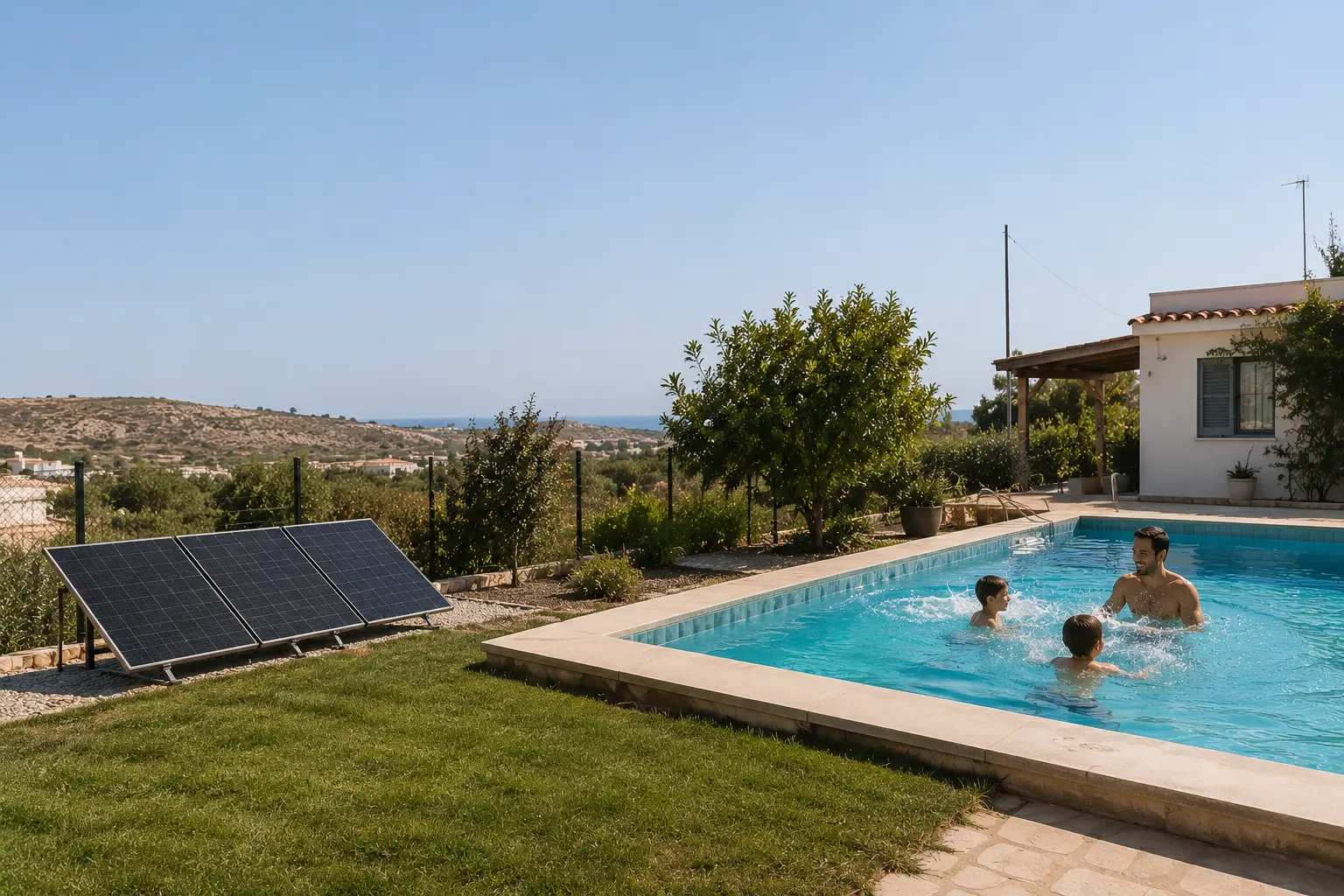
Filtration runs for hours every day, it runs in daylight, and it does not mind exactly when. Very little else in the house is that easy to move onto your own roof.
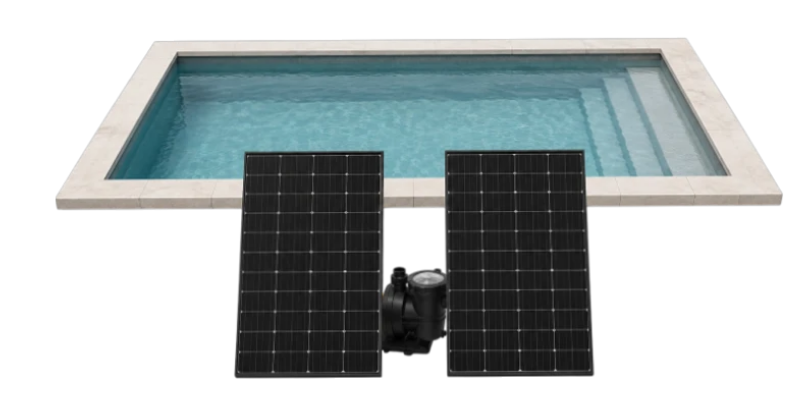
Three parts, and one of them is the pump you already own a version of. A few panels near the pool or on a roof, a small controller, and a pump that runs on direct current straight from the panels. No inverter, no battery, no new wiring in the house.
1The panels make the power.Two to four of them, beside the pool or on a roof that catches the middle of the day.
2The controller takes the most it can.It follows the panels through the day and passes the pump whatever they are giving at that moment.
3The pump follows the sun.It starts itself in the morning, runs at full flow at midday, slows down in the afternoon and stops at sunset.
You save €600 to €900a year, which is the whole electricity cost of running the pump
A rough illustration rather than a quote. Those three numbers come to roughly 2,000 to 3,000 kWh a year, priced at 0.30 per kWh, August 2026. The 300 days are days the pool is filtered rather than days of full sun: the solar pump runs slower on a dull day rather than stopping, and it costs nothing either way. Your own pool is measured at the survey.
Six hours a day for most of the year, bought at the retail price, is what the pump you have now costs to run. The solar one has no grid connection at all, so there is no electricity to buy for it.
What changes with the weather is how much filtering you get in a day, not what it costs you. On a dull day the pump turns more slowly and keeps going.
Does a solar pool pump need a new EAC application?
No. The panels feed the pump and nothing else, and nothing ever reaches the grid, so there is no export to apply for. We confirm what applies to your property at the survey.
Sometimes, but usually it is not worth it. Most existing pumps are old single phase motors that waste energy no matter what feeds them. The complete kit replaces the pump with a far more efficient DC motor, which is where a big part of the saving comes from. For larger pools with modern three phase pumps a retrofit solar drive can make sense, and we assess that at the survey.
Less than the pump it replaces, in most cases. It spends most of its time well below full speed, and noise falls away faster than speed does.
Run your pool on sunshine
Tell us about the pool and the space around it, and we will work out what it uses today, what it would take to run it on its own panels, and what that is worth over a year.
If your existing system can already carry the pump, we will tell you that instead.
Solar pool pumps, properly explained
Everything above answers whether this is for you. Below are the nine questions people ask before they buy, in the order they usually come up.
1. What does a pool pump cost to run?
More than most people expect. Around six hours a day for most of the year comes to roughly 2,000 to 3,000 kWh, which after the air conditioning is usually the largest single use of electricity in the house.
A pool pump is easy to forget because nobody switches it on. It runs on a timer, in a plant room, doing a job that has to happen whether anyone swims that day or not.
That is exactly what makes it expensive. It is not a peak you can see on a bill, it is a floor under the whole year, and it is bought at the retail price of electricity every hour it runs.
It runs most days of the year rather than only in the season
It runs for hours at a time, not minutes
It runs in the middle of the day, when electricity is most in demand
It is the one large load in the house that nobody is choosing to use
The pool pump is a fixed cost that arrives every year. That is what makes it worth moving first.
2. How does a solar pool pump work?
Three parts. A few panels, a small controller, and a pump whose motor runs on direct current. The panels feed the pump and nothing else.
The panels make direct current. An ordinary solar installation would convert that to the alternating current a building runs on, and the conversion is why an ordinary installation needs an inverter.
This pump does not need one, because its motor runs on direct current already. The controller sits between the panels and the motor and does one job: it holds the panels at the point where they give the most power at that moment, and passes it straight to the pump.
Nothing in the house is involved. There is no connection to your fuse box, no connection to the grid, and no effect on a solar system you already have or plan to add.
1
The panels
Two to four of them, beside the pool or on a roof that catches the middle of the day.
2
The controller
It takes the most the panels can give at any moment and passes it to the motor.
3
The pump
A brushless motor that runs on direct current, in the pipework the old pump was in.
Three parts, and no inverter between them.
The panels are wired to the pump rather than to the building. That is the whole system.
3. What happens across a day?
It starts itself in the morning, runs at full flow around midday and stops at sunset. The six hours a pool needs land in the sunniest part of the day without anyone setting a timer.
The pump follows the light rather than a clock. As soon as the panels give enough to turn the motor, it starts, and it speeds up as the sun climbs.
That also means it keeps working on a hazy morning or a dull day. It runs slower rather than stopping, and slow water through a filter still cleans it.
1
Morning
The pump starts on its own as soon as the panels carry it, and runs gently.
2
Midday
Full flow, in the hours the pool is warmest and most used.
3
Afternoon
It slows down again as the sun drops, still turning the water over.
4
Night
It rests. The pool is clean and nothing is drawing electricity.
No timer to set, and nothing to switch on.
The pool is filtered on the sun's schedule, which is the same schedule the pool is used on.
4. Is the water still properly filtered?
Yes, and usually better than before. Slower water through the filter for more hours cleans more thoroughly than a short run at full speed.
Most pools have a single speed pump. It has one setting, runs flat out for a set number of hours and then stops, whatever the pool needs that day.
A pump that varies its speed can do the same work gently. Moving water slowly through a filter takes far less power than moving it quickly, so the same turnover spread across more hours asks much less of whatever is feeding it, and the filter gets more time to do its job.
The other two things you notice are noise and wear. A pump below full speed is quieter, and it is easier on the seals, the filter and the pipework it is joined to.
Single speed
One setting, on or off. It asks the same of the supply whatever the weather is doing.
Suits The pump most Cyprus pools have today.
Variable speed
Runs at whatever speed the light allows, for longer, and quietly.
Suits Any pool in regular use, and any pool whose pump is due for replacement.
The speed is where most of the benefit lives.
Longer and gentler is better filtration, not a compromise you accept to get the solar.
5. Do you need a battery or a grid connection?
No to both. The pool is the storage: water filtered during the day stays clean through the night. A grid connection can be added as a backup, and most pools never need it.
A battery earns its place when you want electricity at an hour you cannot produce it. The pool does not: it is filtered while the sun is up and it stays clean after dark, so there is nothing to keep until the evening.
Because nothing ever flows towards the grid, there is also nothing to apply for. No EAC application, no waiting, and no change to a system already on the roof. We confirm what applies to your property at the survey rather than guessing it from the address.
The pool stores its own work. That is why this is the simplest solar you can buy.
Enough to turn the pool's water over once a day. For a private pool that means a pump in the small kilowatt range and a handful of panels.
Sizing starts at the volume of water and the turnover it needs, which is the same rule that decided the pump you have now. From there it is a question of how much power the panels have to deliver across a day to reach it.
Space matters as much as arithmetic. The panels need somewhere that catches the middle of the day, and that is usually easier at a pool than on a roof, because there is ground and there is often a pergola.
The exact pump and the exact number of panels come from the survey. A quotation that has not measured the pool has not been designed.
One turnover a day is the target. Everything else is the arithmetic that gets there.
7. What if the house stands empty for weeks?
The pool looks after itself, and it costs nothing to do so. This is the case holiday homes and rental properties buy it for.
An empty house is where an ordinary pool goes wrong in both directions. Leave the pump running and you pay for electricity nobody is using; switch it off and you come back to a green pool.
A pump on its own panels removes the choice. It runs every sunny day whether or not anyone is there, on electricity that costs nothing, and it stops when the sun does.
A pool nobody is standing next to is the case this suits best, and the one it was easiest to get wrong before.
8. What does installing and looking after it involve?
The new pump goes into the pipework the old one was in, usually in a day. After that it is the same care as any pool pump.
The work is smaller than people expect. The pump is replaced in place, the panels go up nearby, the controller is mounted between them, and there is no work inside the house at all.
Maintenance is what you already do: keep the strainer basket clear and the filter clean. The motor is brushless, so the part that wears out on an ordinary pump is not there, and it usually outlives the one it replaced.
The existing pipework and the existing plant room are used as they are
No work in the fuse box and no new circuits
Panels beside the pool or on a nearby roof
The same weekly care as the pump it replaces
A day's work at the pool, and nothing new to learn afterwards.
9. What should you ask before you buy?
Six questions that separate a system designed for your pool from one sized off a price list.
What turnover does my pool need, and how did you work that out?
It should come from the volume of the water, not from a standard number applied to every pool on the street.
How many panels, and where exactly would they go?
The panels are part of the machine here, so a quotation that has not placed them has not been designed.
What happens on a run of dull days?
You want to hear how the system behaves, not that it will not happen.
What does the pump do in winter, when the pool needs less?
Shorter days and a smaller job should meet in the middle. An installer who has thought about it will say so.
Who is responsible if the pump and the controller disagree?
Two suppliers and one problem is the situation you are trying to avoid before it exists.
What is the warranty on the pump, and on the work?
These are usually different lengths from different parties, and the difference is worth knowing on the day rather than later.
Written to be read aloud at the kitchen table.
A good answer to any of these is about your pool. A general answer means the design is general too.
Tell us about the pool and the space around it, and we will work out what it uses today, what it would take to run it on its own panels, and what that is worth over a year.